Flashforge AD5X Review
| Product | Score | Print quality & accuracy(25%) | Setup & ease of use(25%) | 3-Year Cost |
|---|---|---|---|---|
 Flashforge AD5XOur Verdict |
7.2 |
8.7/10 |
6.3/10 |
$399.00checked Sep 15, 2026 |
Sorted by score. Prices come from each seller's site on the date shown and change often.
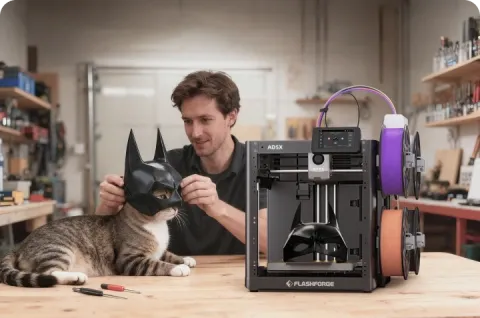
The Flashforge AD5X is a $399 Core XY printer that adds four-color printing through a compact Intelligent Filament System (IFS) module bolted to its right side, instead of a separate AMS-style box. It is the pick for someone who wants clean, high-temperature multicolor parts, PLA-CF included, and is willing to fight a rough slicer to get them. It is not the pick for someone who wants a camera, built-in lighting, or software that just works out of the box.
This is a researched review built from Flashforge’s own product and spec pages, Flashforge’s parts store, and Tom’s Hardware’s published review of the unit, along with an owner-run report on post-launch firmware problems. The Practical Choice did not print on this unit directly. See how we score for the method.
Design and setup
The AD5X ships mostly assembled. Tom’s Hardware’s reviewer had the screen bracket, IFS module and spool holders together in minutes, with no tools needed to mount the touchscreen. The frame is an evolution of the budget Flashforge Adventurer 5M, an open steel skeleton with the same Core XY motion system, now carrying the IFS box and four side-mounted spool holders instead of a single spool.
Two design details stand out. The tool-head cover uses pin connectors instead of a wired fan, so clearing a jam does not mean the cover dangles on delicate cables. The heat break is a two-piece, magnetic design that lets you swap the 0.4 mm nozzle without tools. Bed leveling is fully automatic with auto Z-offset and, per Tom’s Hardware, “works perfectly” at the start of every print.
The rough edges are on the interface side. The 4.3-inch color touchscreen is bright but registers as a tap screen rather than a true touch screen, so menus need repeated presses. There is no camera and no built-in lighting, both sold separately from Flashforge’s store. And loading filament into the spring-loaded spool holders was described as “a little awkward,” though changing filament afterward is simple since the IFS cuts and retracts it automatically.
How it scores
Print quality and accuracy (25%)
This is the AD5X’s strongest category. Tom’s Hardware ran PLA-CF, standard PLA, PETG, TPU and ASA through the machine and reported smooth surfaces with minimal stringing across materials, plus a direct-drive extruder rated to 300C and a bed rated to 110C, enough headroom for PETG and ASA without an enclosure. The one soft spot noted was a bit of layer-line inconsistency on a part printed flat, and slightly more ringing on a PC print, a filament the AD5X has no built-in profile for.
Setup and ease of use (25%)
Hardware setup is genuinely easy: fast physical assembly, automatic leveling, tool-free nozzle changes. Software is the opposite. The bundled Orca-Flashforge slicer crashed roughly every third print in Tom’s Hardware’s testing, does not carry the filament colors you set on the touchscreen over to the slicer’s prepare tab (you have to retype them, and getting it wrong can flush the wrong color at the wrong volume), and never tells you the total filament wasted in color swaps, only the purge tower volume. Flashforge does maintain an official profile for standard OrcaSlicer as an alternative, which Tom’s Hardware called more stable, though it still does not surface total waste.
Speed and build volume (20%)
Flashforge rates the AD5X at up to 300 mm/s print speed, 600 mm/s travel, and 20,000 mm/s2 acceleration. In practice, Tom’s Hardware’s real prints ran well under that: around 180 to 200 mm/s average for PLA and PLA-CF, 100 mm/s for PETG, and as low as 45 to 75 mm/s for TPU and thin-walled parts, which is normal for FDM but worth knowing before you buy on the headline number. Build volume is 220 x 220 x 220 mm, on the small side next to some rivals with 250 mm or 256 mm cubes.
Reliability and support (15%)
Flashforge backs the AD5X with a 12-month limited warranty on the printer and a shorter 3-month warranty on extruder parts, with no documented free extension for registering the printer. Beyond the slicer instability Tom’s Hardware documented, an owner-run report published in May 2026 described firmware update loops with error codes E0120 and E0007 on some units, and said Flashforge silently changed the toolhead’s connector design between a “V1” and “V2” version, which can complicate sourcing compatible spare parts for early units. That report is a personal blog, not a lab test, so treat it as one data point rather than a verdict, but it lines up with the software fragility Tom’s Hardware saw independently.
3-year cost (15%)
At $399 (regular price $549), the AD5X undercuts most enclosed multicolor rivals at purchase. Spare 0.4 mm nozzle assemblies run $29.00 direct from Flashforge, reasonable for a quick-swap part. The real cost variable is filament wasted in color changes, see the math below, which is not a fixed, brand-documented consumable and depends entirely on how many colors and swaps a given model uses.
The Practical Math
The only line item Flashforge documents that belongs in a 3-year cost total is the printer itself: $399.00 at the current sale price. Flashforge does not publish a fixed filament, nozzle, or part replacement schedule for the AD5X, and rated wattage is not listed on the product page, so this review does not add invented consumable or electricity totals to that number.
What is worth budgeting for is purge waste. In Tom’s Hardware’s testing, a simple two-color print defaulted to a 540 cubic millimeter purge, about 0.67 grams of filament, per color swap. A more demanding model, 33 small articulated frogs with 23 color swaps around one part’s eyeball, wasted 11 grams of filament on a 9-gram object. None of that is fixed or predictable enough to put a dollar figure on here, but it means a spool lasts fewer prints in 4-color mode than the grams-per-print math on a single-color printer would suggest. Optional add-ons, the enclosure kit, camera, and LED lighting sold separately on Flashforge’s store, are extras for a fully kitted-out setup, not required for the printer to work as sold, so they are left out of the total and noted here instead.
Alternatives
Two other multicolor printers are worth cross-shopping before buying. Bambu Lab’s A1 Combo bundles the full-size A1 with one AMS lite unit for automated four-color printing and a 256 x 256 x 256 mm build volume, priced at $649 on Bambu Lab’s US store, a step up in price from the AD5X but built around Bambu Studio, which has a longer track record of stability than Orca-Flashforge. Anycubic’s Kobra 3 Combo pairs the printer with an ACE Pro module rated for 4- or 8-color printing and a 250 x 250 x 260 mm build volume, listed at $355 regular price (with a limited-time offer as low as $329) on Anycubic’s store, closer to the AD5X on price. See our multicolor 3D printer picks for how these compare across more models.
Who should skip it
Skip the AD5X if a stable slicer matters more to you than saving $150 to $250 at checkout, or if you want a camera and built-in lighting without ordering separate accessories. Buyers who print mostly single-color parts, or who already own a reliable slicer workflow and only want the hardware, may prefer a simpler machine. Anyone who wants to compare PLA and PETG before committing to filament for this printer can start with our PLA vs PETG guide, and anyone shopping more broadly should see our best 3D printers picks or, for a first printer, our beginner picks.
FAQ
Is the Flashforge AD5X good for beginners?
The hardware setup and automatic leveling are beginner-friendly, but the bundled slicer’s crashes and manual color re-entry add a learning curve that a first-time printer owner should expect going in.
What materials can the AD5X print?
Flashforge lists PLA, PETG, TPU, ABS and ASA support with a 300C nozzle and 110C bed. Tom’s Hardware also successfully printed PC and lightweight PLA on it, though the AD5X has no built-in profile for either.
Does the AD5X need an enclosure?
Not for PLA, PETG or TPU. For ABS, ASA or PC, an enclosure helps with warping and is sold separately by Flashforge as a DIY panel kit, since the AD5X ships open-frame with no active chamber heating.
How much filament does multicolor printing waste on the AD5X?
It varies by model and color count. Tom’s Hardware measured roughly 0.67 grams per simple color swap and 11 grams wasted across 23 swaps on one small part, since the slicer does not total purge waste automatically.
Is the AD5X reliable long term?
Flashforge’s own warranty is 12 months on the printer and 3 months on extruder parts. Beyond that, reports of firmware update loops and a toolhead hardware change on some units mean buyers should register the printer, keep firmware backups where possible, and watch for official fixes before updating.
Our Verdict: Flashforge AD5X
Flashforge AD5X
Paid link · price checked Sep 15, 2026
What we like
- +Clean, low-stringing results across PLA, PETG, TPU and PLA-CF per Tom's Hardware testing
- +300 C nozzle and 110 C bed handle ASA and PC without an enclosure required for PLA/PETG
- +Compact 4-color IFS module needs no separate AMS box
- +Tool-free nozzle swap with a magnetic two-piece heat break
- +Automatic bed leveling with auto Z-offset described as working perfectly
What we don't
- −Orca-Flashforge slicer crashed about every third print in Tom's Hardware's testing
- −Filament colors set on the touchscreen do not carry over to the slicer automatically
- −Slicer does not total filament wasted in color-change purging
- −No camera or built-in lighting; both are separate paid add-ons
- −Owner-reported firmware update loops and a silent V1-to-V2 toolhead hardware change on some units
Skip it if
Skip it if you want a stable slicer and a camera or lighting built in, not bought as add-ons.
The Practical Math · 3 years
| Flashforge AD5X printer (current sale price, regular $549.00) | $399.00 |
| Total | $399.00 |